
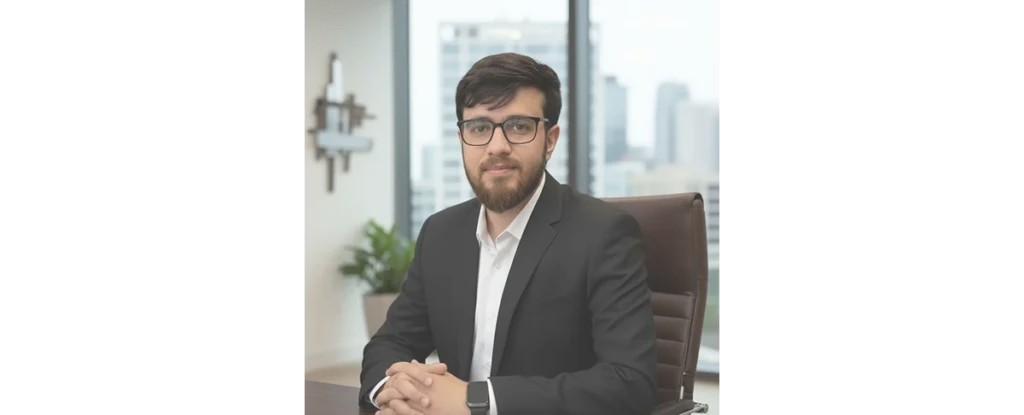
The Designer Who Saw the AI Wave Coming — And Chose to Build It
Aayushman Gupta · March 2026
“I didn’t follow the path. I built one — and it led
straight into the future of AI.”
— Aayushman Gupta
There are two kinds of designers in the age of AI. Those who are scrambling to add it to their work. And those who saw it coming — and built their entire career around it. Aayushman Gupta belongs to the second group. He just didn’t make a lot of noise about it.
By the time most of the industry started asking “how do I add AI to my product,” Aayushman had already spent a decade inside the machine — designing the enterprise-grade AI and infrastructure platforms that most people never see, but every serious company depends on. His perspective isn’t borrowed from keynotes or trend reports. It’s built from scar tissue.
The Industry Is Getting AI-Native Design Wrong
There is a quiet crisis unfolding in the product world. Billions of dollars are being poured into AI features — copilots, assistants, predictive nudges — layered on top of software architectures built for a pre-AI era. The result? Products that feel bolted together. Interfaces that apologize for intelligence rather than celebrate it. Experiences that confuse users more than they empower them.
Most designers were trained to solve for human intent. AI-native design demands something more: solving for human trust — in systems that act, decide, and evolve without explicit instruction. That is a fundamentally different design challenge. And almost no one in the industry was talking about it.
Aayushman Gupta identified this fault line years before it became a headline.
A Decade at the Bleeding Edge
Aayushman’s résumé reads like a map of the enterprise AI landscape: Nutanix, Cohesity, Domino Data Lab, Traceable.ai, Cequence.ai, Prophecy.io, Onehouse.ai. Across ten years, he was consistently the first or founding designer — not hired to polish mature products, but to bring legibility to raw, complex systems at the moment they needed it most.
He was the first designer in India at both Nutanix and Cohesity. He has been a founding designer at multiple AI-first startups. In each of these roles, his work wasn’t about making things look good. It was about making deeply complex, high-stakes systems feel trustworthy, navigable, and human.
That experience — repeated, at scale, across industries — is what makes his perspective on AI-native design not theoretical. It’s earned.
The Dropout Who Never Stopped Learning
In a country where engineering pedigree is treated as destiny, Aayushman walked away from college — not in defeat, but in pursuit. Product design in India, at the time, was barely a career. He chose it anyway.
That early bet against convention became the defining pattern of everything that followed: move toward what matters, not toward what’s expected. Ignore the noise. Build the thing.
It’s the same instinct that now drives his conviction about AI-native design. When the rest of the industry is adding AI features, he asks: what if you designed the product as if AI was the foundation, not the feature?
What AI-Native Design Actually Means
AI-native design is not a UI pattern. It is a philosophy. It demands that designers understand probabilistic outputs, not just deterministic flows. It requires designing for failure states that are intelligent but wrong — a category of error that didn’t exist before. It means constructing trust architectures: the invisible scaffolding that makes users feel safe delegating decisions to systems they cannot fully see or predict.
This is the space Aayushman has staked his career on. It’s also the space he’s now building in — as part of the founding team of a stealth-mode startup designing an agent-driven platform from zero. The ambition is explicit: a billion-dollar, category-defining company, built responsibly, from the ground up, for an AI-first future.
Why This Voice Matters Now
At UXIndia Conference 2025, Aayushman delivered a talk on “Designing for Agentic AI.” Not from slides built on speculation — from the specific, hard-won experience of a decade in the field. The audience wasn’t hearing a trend report. They were hearing from someone who had been inside the machine, designing the systems that agentic AI now runs on.
That is increasingly rare. The loudest voices in AI product design are often the furthest from actual product decisions. Aayushman represents the opposite: a practitioner’s perspective on a practitioner’s problem, at the exact moment the industry most needs to hear it.
He didn’t start with a degree. He didn’t start with a blueprint.
He started with a conviction that design, done right, could make even the most complex systems feel human.
That conviction took him from a contrarian choice in a country that didn’t value it, through a decade of building at the frontier of enterprise AI, and now to the edge of something entirely his own.
The path he built? It was always leading here.
More Stories
VC Circle Bengaluru Launch Boosts VC Collaboration
Sravan Hospitality Leads Certified Services in Vizag
Gytree Launches India’s First AI Health Companion for Women