
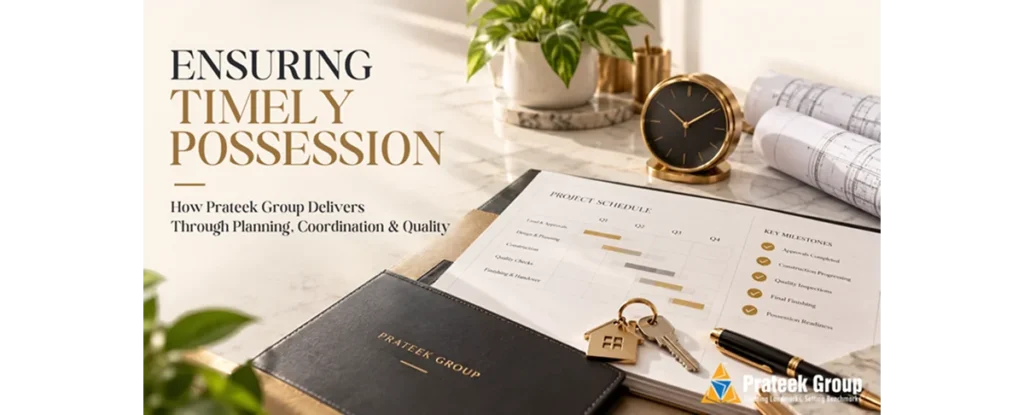
How Prateek Group Ensures Timely Possession for Thousands of Homebuyers
For a homebuyer, a possession date can shape several other decisions.
Rent agreements may depend on it.
Home-loan planning may depend on it.
Families may schedule moves around it.
Schooling, work commutes and major financial commitments can all be affected by when a home is finally ready.
This is why we see timely delivery as one of the most important responsibilities in residential real estate.
But a possession date is only the final visible outcome of a much larger process.
Long before we hand over the keys, our teams have to coordinate design, approvals, procurement, structural construction, contractors, labour, quality control, finishing, services and infrastructure.
For us at Prateek Group, ensuring timely possession is therefore less about one final deadline and more about managing hundreds of interdependent activities throughout the development cycle.
Timely Possession Starts With a Realistic Project Plan
Construction schedules are most useful when they are based on the actual sequence in which a project can be built.
A project cannot move directly from excavation to finishing.
Each stage depends on another.
The structure has to reach the required stage before several internal services can progress.
Services need to be coordinated before finishes are closed.
External development has to align with building readiness.
Testing and inspections come later still.
For us, a realistic schedule therefore has to understand these dependencies from the beginning.
The purpose is not simply to create a target possession date.
We break that date into smaller construction milestones that can be monitored throughout the project.
This helps us understand not only where we want the project to finish, but what has to happen at every stage to get there.
Approvals Are Part of the Delivery Plan
Construction is not governed only by what happens physically on site.
Regulatory approvals and statutory processes also affect the development timeline.
That is why we have to account for approvals alongside construction activity.
Designs must follow applicable norms.
Relevant submissions need to happen at the appropriate stages.
Permissions and compliances have to be integrated into the project programme rather than treated as separate administrative tasks.
For us, the earlier these dependencies are identified, the easier it becomes to reduce uncertainty later.
For our homebuyers, these processes are usually invisible.
But they are an important part of how a project moves from drawings to possession.
The Critical Path Matters More Than General Activity
A construction site can appear extremely busy and still be behind schedule.
Dozens of activities may be happening simultaneously, but not all of them have the same impact on the final possession date.
Some activities sit on what project managers call the critical path.
If those activities are delayed, the overall project completion date may also move.
This is why our teams need to understand not only how much work has been completed but which unfinished activity is capable of affecting the next stage.
For example, a delay in one finishing item may be manageable.
A delay in a structural or services-related milestone may affect several subsequent activities.
For us, timely delivery therefore depends on prioritisation as much as progress.
Parallel Work Can Improve Efficiency
Large Residential Projects in NCR are rarely built through one activity at a time.
Different areas of a development can progress simultaneously.
Structural work may continue in one section while internal services are underway elsewhere.
Façade work can progress on completed structures while other towers continue moving vertically.
External development can begin in areas where heavy structural activity has reduced.
This ability to create multiple work fronts can help us use time more efficiently.
However, parallel execution only works when activities are properly coordinated.
Too many contractors working in the same area can create interference.
Materials can block movement.
One team may damage work already completed by another.
Our objective is therefore not to maximise activity everywhere.
It is to sequence activities so that multiple teams can progress without repeatedly creating rework for one another.
Contractor Coordination Is Central to Delivery
A residential project brings together many specialised agencies.
Civil contractors.
Mechanical and electrical teams.
Plumbing contractors.
Façade specialists.
Lift providers.
Landscape contractors.
Interior finishing teams.
Fire-safety specialists.
Infrastructure agencies.
Each may operate on its own work schedule.
Our role is to bring these schedules into one overall programme.
This makes contractor coordination one of the most important parts of our project execution.
If one agency falls significantly behind, several other teams may be unable to begin their work.
Regular coordination helps us identify these dependencies early.
At Prateek Group, managing multiple contractors within one construction programme forms part of the larger discipline required to move a project steadily towards possession.
Procurement Has to Match Construction
One of the easiest ways for a construction programme to lose time is for material to arrive after it is needed.
Residential projects use hundreds of material categories.
Some can be sourced relatively quickly.
Others require manufacturing, approvals, custom specifications or longer delivery periods.
A lift package does not follow the same procurement cycle as cement.
Façade systems do not follow the same cycle as basic reinforcement steel.
Certain electrical or mechanical equipment may require advance ordering.
Finishing materials may have entirely different lead times again.
For us, procurement cannot function independently of the construction schedule.
We have to work backwards from when each item will be required on site.
As a Trusted Builder in NCR, effective procurement planning helps us reduce stoppages caused by material shortages while also avoiding unnecessary storage of materials months before they are needed.
Material Planning Also Protects Quality
Procurement is not only about speed.
Quality matters as well.
We cannot simply replace a specified material with whatever happens to be available if doing so affects performance or promised specifications.
That creates an important balance.
Materials need to be available on time.
But they also need to meet the required technical and quality standards.
This is why specification reviews, sample approvals and quality checks become part of timely delivery.
If the wrong material reaches the site and has to be rejected later, time is lost twice: once during the original procurement and again while arranging a replacement.
For us, good quality control therefore supports timelines rather than competing with them.
Preventing Rework Is One of the Best Ways to Save Time
Some delays happen because work starts late.
Others happen because work has to be done again.
Rework can occur when drawings conflict, execution does not match specifications, services clash or quality standards are not met.
Each correction consumes additional labour, material and time.
This makes coordination before execution extremely valuable.
Detailed drawings and interdisciplinary reviews can help identify potential conflicts before our teams encounter them physically on site.
For large Residential Projects in NCR, even small improvements in reducing repetitive rework can have a meaningful impact because the same detail may appear across multiple floors, towers or apartments.
For us, timely possession is therefore not always about making construction faster.
Often, it is about avoiding work that should never have needed to be repeated.
Standardisation Can Improve Predictability
Repetition is common in residential construction.
Floor plates repeat.
Apartment configurations repeat.
Structural elements repeat.
Many services follow similar routes across multiple levels.
When these repeated activities can be standardised, construction becomes easier to plan.
Our teams develop familiarity with the sequence.
Material requirements become more predictable.
Quality benchmarks can be repeated.
Productivity can improve as the workforce becomes accustomed to the system.
Across our portfolio, we have also adopted construction approaches such as Mivan formwork where relevant.
For us, the significance of such systems is not simply that they may allow faster execution.
Their larger advantage can be predictability.
If a repetitive structural cycle becomes more consistent, the programme built around that cycle can also become easier to manage.
Site Reviews Help Convert Plans Into Action
A schedule is useful only if actual progress is compared against it.
Construction therefore requires regular review.
How much was planned?
How much was completed?
Why did a particular activity fall behind?
Does that delay affect another contractor?
Can resources be shifted?
Does the sequence need to change?
These questions allow us to identify slippage before it becomes difficult to recover.
At Prateek Group, disciplined progress monitoring forms part of our larger delivery process.
Small deviations are easier to address early.
Once several delays accumulate, recovery becomes significantly more difficult.
Escalation Matters When Something Goes Wrong
No construction programme works exactly as planned.
Weather can affect activity.
Material deliveries can be disrupted.
Contractors can face manpower shortages.
Equipment can fail.
External circumstances can change.
For us, the important question is not whether a project ever faces a problem.
It is how quickly that problem is recognised and escalated.
A clear escalation system allows our site teams to raise issues that cannot be solved at their own level.
Decisions can then move to the appropriate technical, procurement or management team without unnecessary delay.
This is one of the less visible parts of project execution.
But it is essential.
A problem that takes one day to identify and solve has a very different impact from one that remains unresolved for several weeks.
Financial Planning Supports Construction Continuity
Construction requires continuous financial coordination.
Payments to contractors, procurement of materials, equipment, infrastructure development and finishing activities all require capital at different stages.
A delay in financial decision-making can eventually become a delay on site.
This makes project finance part of our delivery planning.
Our construction teams may be responsible for physical execution, but our financial teams also need to ensure that the programme remains supported at each stage.
For us as a developer handling multiple projects, this becomes particularly important because capital requirements can overlap across several sites.
As a Trusted Builder in NCR, we believe engineering discipline and financial discipline have to support each other.
One cannot compensate indefinitely for weakness in the other.
Quality Checks Should Happen During Construction, Not Only at the End
Waiting until possession to identify quality concerns can create major delays.
By that stage, many finishes may already be complete and access to concealed services may be difficult.
Our approach therefore has to include inspection throughout construction.
Structural checks happen during structural activity.
Services are inspected before they are covered.
Finishes are reviewed as they progress.
Mock-ups can be used to finalise important details before the same work is repeated hundreds of times.
This stage-wise approach helps us identify problems when they are still relatively easy to correct.
At Prateek Group, quality control and delivery therefore need to move together.
A project that reaches possession quickly but requires extensive correction afterwards has not truly been delivered efficiently.
Risk Planning Becomes More Important in Uncertain Conditions
Construction does not happen in a controlled environment.
External events can affect labour, transportation, material availability and site operations.
The COVID-19 pandemic demonstrated this across the Indian real estate sector.
During that difficult period, our published records state that we delivered more than 4,500 homes during 2021 and 2022.
For us, the useful lesson from that period is not simply the number.
It is the importance of resilience.
Projects need the ability to reorganise work, restart activities, remobilise labour and adjust procurement when normal assumptions no longer apply.
Risk planning cannot predict every disruption.
But it can make us better prepared to respond when one occurs.
Handover Readiness Is More Than Finishing an Apartment
We do not consider a home ready simply because the apartment interiors look complete.
Possession depends on a much wider set of conditions.
Access areas need to be functional.
Relevant services need to be operational.
Common areas connected to the handover process must be sufficiently ready.
Testing and inspections have to be completed.
Required documentation needs to be prepared.
Internal snagging needs to identify incomplete or defective items.
This final phase can become a bottleneck if it is left until the last moment.
That is why we believe preparation for handover should begin before the final construction activity is complete.
Our teams can create checklists, identify pending items and close issues progressively rather than discovering everything at once near possession.
Thousands of Small Decisions Create One Possession Date
To a homebuyer, possession appears as one date.
Inside a project, that date is created through thousands of decisions.
When should a material be ordered?
Which activity needs to be completed before another begins?
Which contractor requires additional manpower?
Which delay is critical?
Which quality issue needs immediate correction?
Which external risk requires a contingency plan?
Which stage is ready for inspection?
For us, project execution is the cumulative result of those decisions.
That is why our ability to manage delivery depends not on one single process but on the coordination of planning, engineering, procurement, finance, quality and site management.
Timely Possession Is Ultimately About Predictability
We understand that homebuyers know construction is complex.
What they value is confidence.
Confidence that progress is being monitored.
Confidence that problems are being addressed.
Confidence that we understand what remains to be done.
And confidence that the promised home is moving steadily from plan to reality.
For us as a Trusted Builder in NCR, this predictability forms an important part of credibility.
Timely possession does not begin in the final months before handover.
It begins when we plan the project.
It continues through every procurement decision, contractor review, quality check and construction milestone.
And it ends only when all those moving parts come together in one simple moment:
When we place the keys to a home into the hands of the family that has been waiting for it.
More Stories
Kyptec LifeStyle® 620 Bluetooth Headphones with Hybrid ANC
Kyptec LifeStyle® 610 Earbuds: Hybrid ANC and Deep Bass
Kyptec Automation® USB 3.0 Machine Vision Camera Cable